Why 80% of Startups Aren't Actually Ready for Funding
Table of Contents
You Think You're Ready. The Investor Across the Table Disagrees.
Here's the uncomfortable truth: roughly 80% of founders who actively pitch investors are not actually ready for funding, and most have no idea. They have a deck, a demo, and a dream. What they don't have is the one thing every serious investor is quietly grading them on: proof.
If you're searching "how can I get funding for my startup?", the honest answer isn't "send 200 cold emails." The honest answer is: get ready first. Because the cost of pitching before you're ready is not zero. You burn warm intros, you get filed as a "no" in CRMs you'll need later, and you train yourself to take rejection as feedback when it's really a verdict on readiness.
This guide is the funding readiness breakdown I wish every founder got before they queued up their first investor meeting.
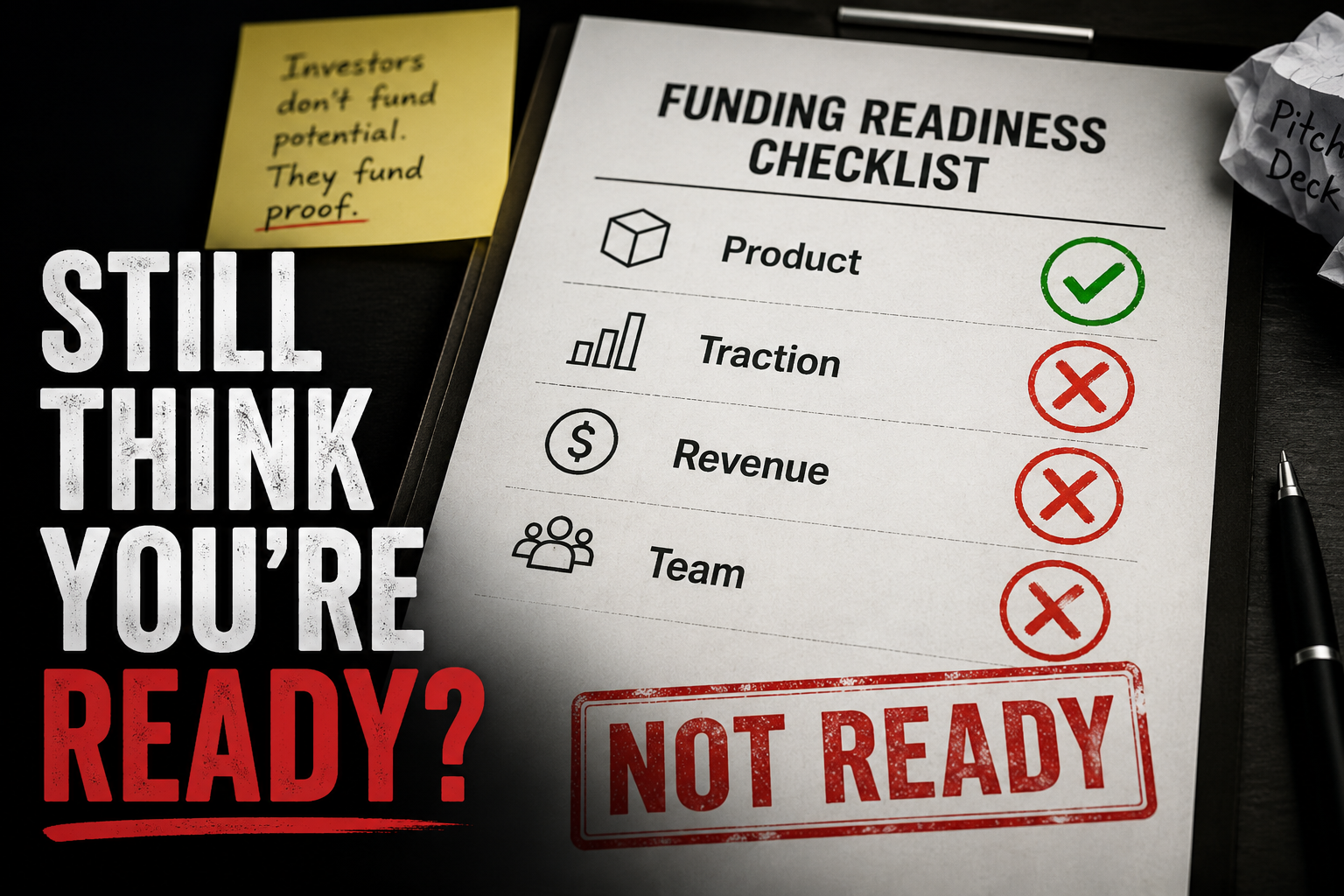
The Hard Rule: Investors Don't Fund Potential. They Fund Proof.
Let me say it plainly, because polite versions of this sentence are killing your round:
Investors fund de-risked bets, not optimistic ones. Their job is not to discover diamonds in the rough. Their job is to deploy capital where the probability of a return is high enough to justify the risk profile of their fund.
That means when you pitch potential, you are asking them to do work they aren't paid to do, namely, imagining your future for you.
The Exception (Be Honest About Whether It Applies to You)
There is an exception, and you should be honest with yourself about whether it applies:
If two or more of those are true, investors will sometimes fund potential, because your background itself is a form of proof. The bet is on pattern recognition, not on your slide deck.
If none of them are true, and that's most founders, you do not get to pitch potential. You have to pitch proof.
What an Investor Is Actually Looking For
Imagine you're across the table from a partner at a Tier 1 fund. They have 30 minutes. Behind their friendly questions is a checklist. Here's what's on it.
1. Traction (the single biggest filter)
Before product-market fit, traction is the closest thing investors have to evidence that the world wants what you've built.
They want to see at least one of these, ideally trending up week-over-week or month-over-month:
A flat line is a "no." A spiky line with no retention is a "no." A clean up-and-to-the-right curve, even at small absolute numbers, opens the door.
2. A Team That Can Actually Build This
Investors back people first, market second, product third. They are looking for:
A solo non-technical founder with no co-founder and no CTO is one of the fastest ways to get filtered out at seed.
3. A Market Worth the Trip
Investors don't just want a good business. They want a business that could be enormous. That means:
4. Defensibility
"Anyone could build this in a weekend" is not investable. Investors want to see at least one of: proprietary data, network effects, distribution advantage, regulatory moat, deep technical IP, or unfair access to a key channel.
5. Clean, Boring Operations
This is where most founders quietly lose the round, and it has nothing to do with the pitch.
The Founder Killers Nobody Talks About: Documentation and Accounting
I have watched promising rounds fall apart in due diligence, not in the pitch. The cause is almost always the same: the company is real, but the paperwork is not.
Stop Running Your Startup on Excel
If your accounting lives in a spreadsheet, you do not have accounting. You have a journal. The moment a serious investor moves to term sheet, they will request:
A spreadsheet cannot produce these in a defensible, audit-ready format. Worse, spreadsheets are easy to "accidentally" massage. Investors know this, and they discount any number that comes from one.
Use Audit-Ready Accounting Software From Day One
Pick a real accrual-capable accounting system early. QuickBooks Online, Xero, NetSuite, Sage Intacct, Wave, or Zoho Books are all defensible choices depending on your size and geography. The non-negotiables:
If a future auditor or VC analyst can't trace a number from your investor update back to a journal entry back to a bank line, you do not have audit-ready books, and that fact will surface during diligence at the worst possible moment.
Document Everything, Early
Things that feel premature at pre-seed and become deal-breakers at Series A:
A founder who shows up to diligence with organized data room folders signals operational maturity. A founder who emails attachments one by one signals risk.
Define These Numbers Before You Pitch
Investors will ask. If you fumble the definitions, they assume you don't run the business by the numbers, which is a polite way of saying they assume you don't run the business.
Memorize these:
If you can't recite your CAC, LTV, gross margin, burn, and runway in plain numbers without checking notes, you're not ready.
Frequently Asked Questions From Founders
How do I know if my startup is ready for VC funding?
You're VC-ready when you can show a clean trend line of growing revenue or engaged users, a credible team with at least one technical leader, audit-ready financials, and a believable bottom-up TAM. If any of those four are missing, you are earlier than you think.
How can I get funding for my startup if I don't have traction yet?
Three honest options: (1) bootstrap or get a friends-and-family round to manufacture traction, (2) raise a pre-seed off network and credibility if you genuinely have it, or (3) apply to an accelerator (YC, Techstars, regional equivalents) that is built to fund pre-traction founders. Cold-emailing Sequoia with a deck is not option four.
What financials do investors want to see at seed?
At seed: 12–24 months of monthly historicals if you have them, a 24-month forward model with assumptions, a cap table, and a use-of-funds slide tied to specific milestones. All produced from a real accounting system, not Excel.
Do I really need a technical co-founder?
For most software and AI businesses, yes. Outsourcing core engineering at the seed stage is a yellow flag for almost every institutional investor. If you don't have a technical co-founder, finding one is usually higher leverage than fundraising.
How long does it take to get ready for funding?
Realistically, 3 to 9 months of focused work to get traction, financials, documentation, and team in shape, assuming you start now. Trying to compress that into "this quarter" is how you get the wrong round at the wrong terms or, more often, no round at all.
A Quick Self-Diagnostic
Be brutal. For each, answer yes or no:
1. Can I show 6+ months of growth in revenue, paid users, or engaged users with a clear monetization path?
2. Do I have a technical co-founder or technical executive on the team?
3. Can I produce monthly P&L, balance sheet, and cash flow from real accounting software in under 24 hours?
4. Is my cap table on Carta, Pulley, or equivalent, and does it match my legal docs?
5. Can I quote my CAC, LTV, gross margin, burn, and runway from memory?
6. Do I have a written, defensible answer to "why now" and "why you"?
7. Are IP assignments and 83(b) elections complete for every founder and early employee?
Fewer than 5 yeses? You are in the 80%. That's fixable, but it's not fixable in the meeting. It's fixable before it.
Get a Free Funding Readiness Breakdown
If you want a free funding readiness breakdown for your startup, contact me here. I'll review where you actually stand against what investors are looking for, traction, team, financials, documentation, and the story, and tell you straight whether you're ready to pitch, or what to fix first so you don't burn warm investor relationships.
If your story is solid but your deck is letting you down, I also offer pitch deck review and rebuilds, tuned to how investors actually read decks in the first three minutes.
Want to go deeper while you wait? Read Why 95% of Pitch Decks Fail (And How to Fix Yours), How to Pitch Your Startup to a Venture Capital Firm in 2025, and How to Use a VC Directory for Investor Outreach. Then browse the Venture Capital Directory to map the right funds for your stage and geography.
Investors fund proof. Let's make sure yours is ready before they ask for it.
Further Reading: Find the Right Investors
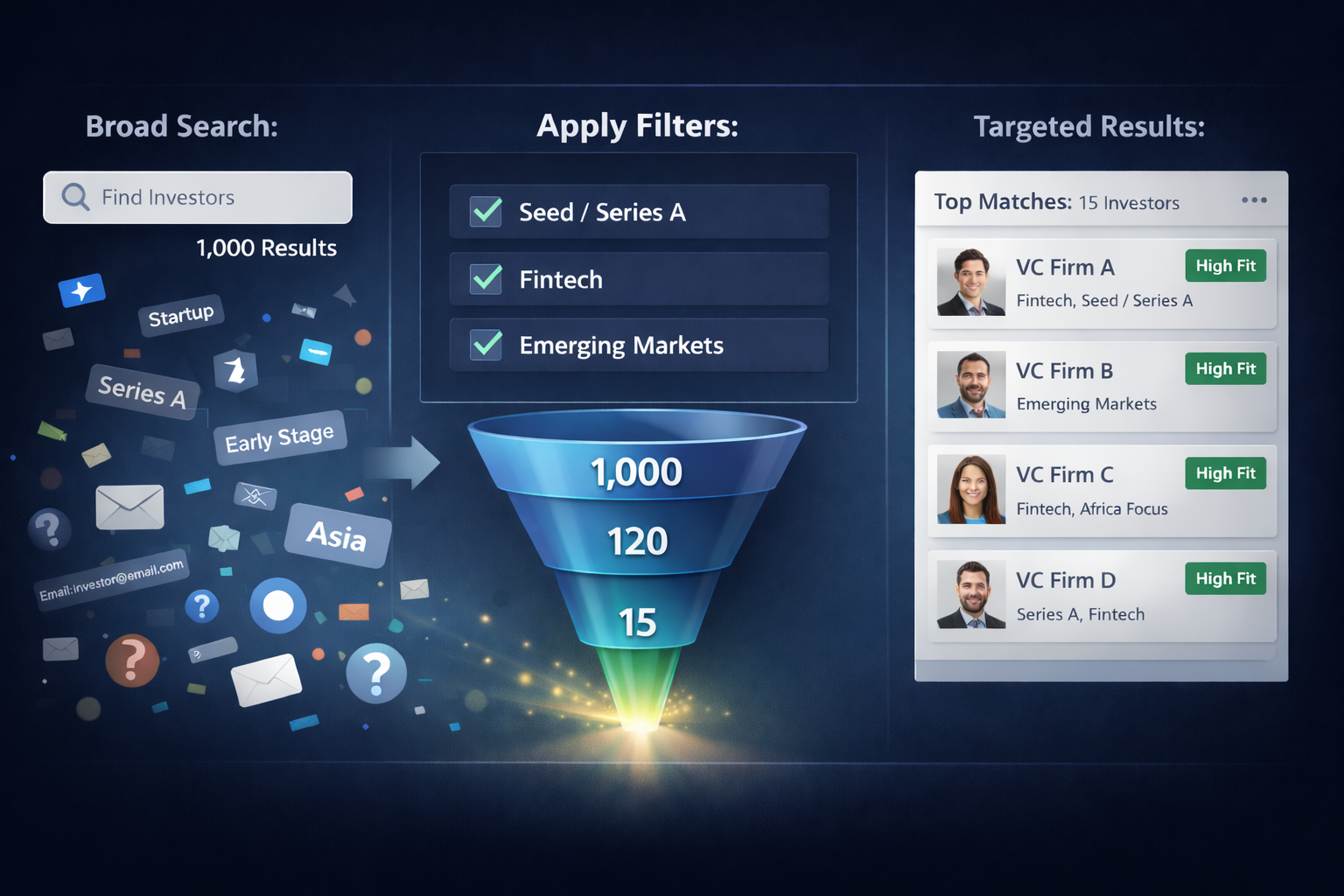
Once your pitch is ready, the next step is targeted investor outreach. Browse our venture capital directory by region to find active funds in Africa, Asia, Europe, Canada, and the United States, or scan the full VC firm list to shortlist firms aligned with your stage and sector.
---
Catherine Oyiliagu (ECO) is a writer and funding strategist focused on startup funding ecosystems, with a particular interest in how venture capital, debt financing, and grants shape growth-stage companies in Africa and emerging markets. She helps founders decode funding signals and build stronger capital readiness narratives.